

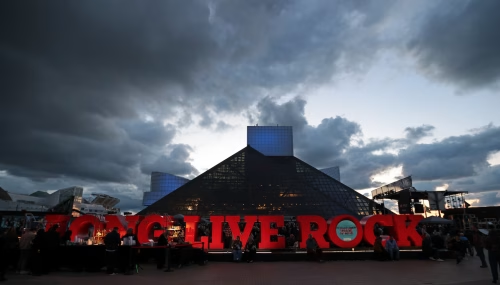
The wait is over! The Rock & Roll Hall of Fame announced its 2026 induction class last month, which includes artists like Oasis, Joy Division/New Order, Billy Idol, Phil Collins, Wu-Tang Clan, Iron Maiden, Luther Vandross, and Sade, finally cementing their place in music history.
The ceremony will take place November 14, 2026, at the Peacock Theater in Los Angeles before airing on ABC and Disney+ later this year, with dates and ticketing details to be announced at a later date.
While many fans are celebrating these long overdue inductions for artists like Wu-Tang Clan, Iron Maiden, and Sade, the announcement has also sparked the conversation that follows nearly every Hall of Fame announcement: Who is still missing? Who is still being overlooked?
The Hall of Fame has faced criticism over the years for its tendency to prioritize traditional classic rock narratives, often entirely formed by white men, while overlooking punk, alternative, hip-hop, and female artists, as well as influential Black musicians whose impact on music history and rock as a whole is simply undeniable. Though the Hall has become more diverse in recent years, many major artists still remain outside its doors despite shaping entire genres and generations of musicians.
With that in mind, here are 10 artists that are still not in the Rock & Roll Hall of Fame, but definitely should be.
1. The Smiths

At this point, it feels more like delay than debate, and a wholehearted snub. While Morrissey’s character is certainly indefensible, The Smiths defined the emotional and sonic language of indie rock, and Johnny Marr’s guitar work is still everywhere in modern alternative music. Their influence is undeniable, even if the Hall hasn’t caught up to it yet.
2. Pixies

Pixies essentially built the framework for 90s alternative rock dynamics. Nirvana has openly credited them, especially for shaping the loud-quiet-loud structure that became a defining sound in the grunge scene. Their impact already circulates the Hall through other bands… just not them.
It is also often forgotten how important Kim Deal was in that dynamic — her bass lines, harmonies, and vocal presence gave the band a tension and texture that truly defined their sound and helped them stand out. Pixies were able to push away from the squarely male-fronted band image largely thanks to her, and it only helped propel their success.
3. Sonic Youth

Sonic Youth made experimental noise part of rock’s actual vocabulary, but part of what made them so important was the way Kim Gordon redefined what a woman in rock could look and sound like. She wasn’t positioned as a traditional frontwoman, but instead was a creative, driving force ingrained in the band’s identity. Her presence helped open the door for a lot of women in indie and experimental rock who didn’t fit the usual expectations of what “female roles” in rock bands were supposed to be.
4. Blue Öyster Cult

Blue Öyster Cult feels like one of the stranger omissions to the Hall because their influence is already so deeply embedded in hard rock and metal history. They simply cannot be reduced to “(Don’t Fear) The Reaper,” as their impact goes far beyond a single hit. They helped push hard rock into darker, more atmospheric territory at a time when heavy music was still evolving its identity. What made them stand out was their willingness to blend theatricality, psychedelia, and heavier guitar-driven rock into something that felt both mysterious and accessible.
5. Alice in Chains

Alice in Chains brought a different kind of weight to grunge where it was less about external rebellion and more about a quiet internal collapse — something fans could really relate to.
A lot of what set them apart was the vocal interplay between Layne Staley and Jerry Cantrell, which created a layered, almost uneasy harmony that felt emotionally unstable in a way most rock at the time wasn’t willing to sit with. That tension ended up becoming a blueprint for a lot of alternative and hard rock that followed, especially for bands that leaned into atmosphere, discomfort, and emotional heaviness instead of straightforward aggression.
6. Bad Religion

Bad Religion helped define melodic hardcore punk in a way that still echoes through modern punk bands, even if they don’t always get directly credited. Their sound is fast, structured, and heavily lyrical in a way that pushes punk beyond what is often perceived as chaos into something more “intellectual” without losing the definitive urgency.
Part of why their absence stands out is because punk itself is still unevenly represented in the Hall compared to other rock subgenres. Bad Religion sits at the center of that gap: they are not just a successful punk band, but also one that helped shape how politically conscious punk would sound for decades afterward. A lot of modern punk bands still borrow their cadence, structure, and tone, even when they’ve evolved the sound in different directions.
7. Motörhead

Motörhead is one of those bands that make genre definitions feel kind of irrelevant. While they’re often labeled as metal, their speed, distortion, and attitude sit right in the space between punk and heavy rock, and that genre blur is what has made them so influential.
Their impact shows up in both punk and metal scenes in ways that are almost impossible to separate. Thrash metal, speed metal, and even hardcore punk all carry traces of what Motörhead has immortalized: louder, faster, and less polished as a choice rather than a limitation. They helped turn aggression into structure, and that shift shaped entire branches of heavy music that followed.
8. The Replacements

The Replacements never fit cleanly into any polished version of rock history, and that’s arguably why they matter. They were inconsistent, unpredictable, and often intentionally rough around the edges, but that approach ended up influencing a huge part of alternative rock’s identity and was something fans could easily relate to. Rawness as an idea became a foundation for a lot of indie and alternative rock in the ’90s and 2000s, when emotional honesty and messiness became part of the aesthetic rather than something to clean up. Their influence isn’t always direct, but it shows up in how so many bands later approached authenticity.
9. X-Ray Spex

X-Ray Spex, led by Poly Styrene, was one of the most important early UK punk bands, but what makes them stand out is how much they challenged the visual and cultural expectations of punk itself. They were obviously contributing to the sound of the genre and inspired others, while they also actively pushed against what it was supposed to look like.
Poly Styrene’s presence as a mixed-race woman fronting a punk band in the late 1970s mattered in a scene that was still defining its identity. Her lyrics directly confronted consumerism, identity, and social expectation in a way that made X-Ray Spex feel both chaotic and intentional at the same time. Their influence becomes even clearer through later movements like riot grrrl, where questions of gender, voice, and visibility in punk were pushed further into the foreground.
10. Lauryn Hill

Lauryn Hill doesn’t sit neatly inside rock history, but her absence still matters in the larger conversation about what the Rock Hall chooses to recognize as foundational influence. The Miseducation of Lauryn Hill reshaped how vulnerability, songwriting, and genre blending could exist in Black music, hip-hop, and R&B. What makes her influence so far-reaching is how often it crosses genre lines. Her approach to storytelling and emotional delivery has been cited by artists across R&B, hip-hop, indie, and even alternative spaces where genre boundaries are increasingly blurred.
The Rock Hall has certainly evolved, especially in its recognition of hip-hop, R&B, female artists, and international acts. However, it still often feels like it is reacting to history rather than fully reflecting it. One of the biggest criticisms surrounding the Rock Hall is that it often spends years “catching up” to artists whose importance was already obvious long ago.
Rock music itself was built directly from Black musical traditions like blues, gospel, soul, and rhythm and blues, yet many foundational Black artists and genres historically received recognition far later than their white rock counterparts.
Additionally, women have been dramatically underrepresented among inductees, with artists like Kate Bush, Chaka Khan, and Cher having waited years or even decades for recognition. Even within already influential bands, women’s contributions are often flattened or overlooked entirely in favor of male frontmen, despite being central to the sound and identity of the music.
Yet, every induction class will still spark the same questions: who gets remembered as essential to music history, and who gets left waiting outside? And maybe more importantly, who gets to decide what “essential” even means in the first place?


Inv terms of musical and historical importance, and legacy, I would have put the name of Siouxsie And The Banshees before Sonic Youth’s and X-Ray Spex’s. Some things matter.