

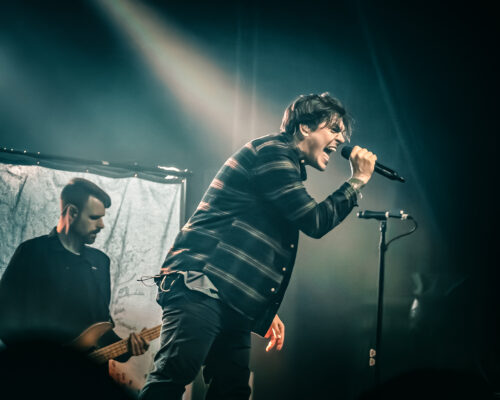
What comes to mind when you think of emo music? For some, the word “emo” may bring to mind images of a young Pete Wentz of Fall Out Boy with sideswept bangs and thickly lined eyes. For others, it may conjure memories of lying on the floor next to their stereo screaming along to the angsty lyrics during their early teenage years.
Emo music has historically been very polarizing with its mathy guitar riffs, crashing drums, and scream-sung vocal delivery. Often unpolished and a bit rough around the edges, the emo-sphere, as a whole, certainly isn’t for everyone. However, the genre has enjoyed steady popularity throughout the past few decades thanks to its raw honesty and relatability.

The first wave of emo rose up in the mid-1980s in Washington, D.C., as “emotional hardcore,” or “emocore,” with roots in hardcore punk, which was becoming more and more aggressive at the time.
Formed in 1983 Rites of Spring, who is now deemed a pioneer of the emo genre, shared in an interview with Mark Prindle that they “never recognized ’emo’ as a genre of music.” Even though they themselves rejected the idea of an emo genre, they were one of the first to pivot away from hardcore punk’s increasingly violent style by becoming a little more poetic in their lyrics.
Several other bands in the punk scene soon followed suit, such as Embrace and Beefeater. This first era is now known as “Revolution Summer” in the emo scene, referring to the period in which bands were experimenting with anti-violent sentiments and sounds.

Although the term “emo” was rejected by its very forefathers, the genre gained more traction in the 1990s. Leading to the second wave of the genre, it began to spread across the country and was already taking on different subgenres.
Most notably, what we now know as Midwest emo took hold across states like Illinois, Michigan, Minnesota, and Ohio. Characterized by mathy guitar riffs and sad-boy lyrics, Midwest emo was pioneered by the less hardcore and more polished styles of bands like American Football. But not all Midwest emo bands followed suit. Sunny Day Real Estate showcased a bit heavier of a sound and weren’t from the Midwest.
Moving west, emo started to mix with grunge and incorporate styles of bands like Nirvana into the music. Further splintering off from the initial emocore genre, the formation of what some would call screamo started to take shape with bands like Orchid, coming mostly out of California at the time.
As experimentation with emotionally-charged lyrics continued across the country, bands started to fuse together more genres, gathering elements of hardcore, punk, emo, and even pop, giving rise to pop-punk bands like Green Day towards the end of the 1990s.
By the end of the second wave, the term “emo” was being used as a catch-all for any heavy music with emotional lyrical content.

In the 2000s, considered the third wave of emo, the genre was ballooning in popularity, with bands of all different styles falling under the umbrella category. With massive acts like Jimmy Eat World and Saves The Day leading the charge at the beginning of the decade, emo grew from being simply a music genre into an entire subculture.
To read the complete five waves of emo, head to see our issue online or purchase a print copy while supplies last.


