

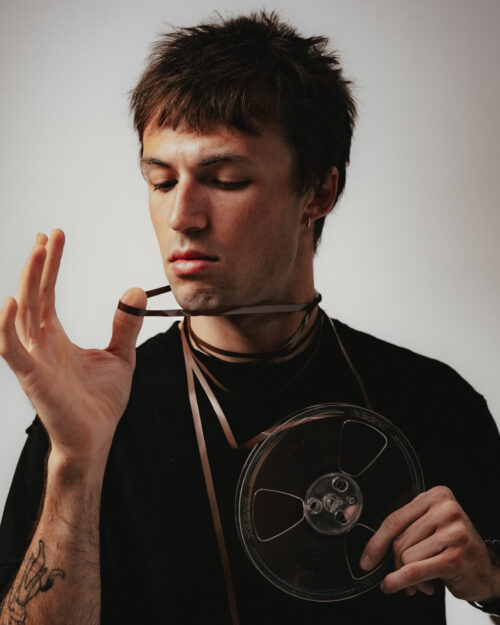
Peter McPoland, with the luck from his four-leaf clover companion, brought a metaphorically driven, exploratory album to life by locking himself in a room full of limitless possibilities with the freedom to create.
Big Lucky is a result of McPoland’s choice to detach himself from the weight of the digital world and discover both himself and his capabilities with a new approach — one where a reel-to-reel tape machine, an iPod full of Beatles songs and scattered maraca beads were involved to make the album all that it turned out to be.
Big Lucky will be released this Friday, Sept. 26, and McPoland is ready for the album to have listeners other than himself. “I’ve been kind of locked up since January, just kind of working on this,” McPoland said. “So I’m glad to get literally anything out.”
McPoland has kept this album mostly hidden from the world, releasing only one single, “Last Looks,” and teasing the tracks “I Love The Animals” and “What Do You Do To Me?“ Comparing it to what it’s like to have a baby, McPoland said releasing only a few pieces from this album has given him more time to sit with it alone. “It’s become such a singular unit to me and I think it gets difficult at times to separate yourself from it and kind of push it out,” McPoland said.
Big Lucky is a complete switch from McPoland’s debut album Piggy, released in 2023, making it seem like the two albums have nothing in common. However, Piggy and Big Lucky are connected by an introspective block McPoland has been, and will continue to be, chipping away at, since it’s a theme that has always been present in his songwriting.
While creating Piggy, McPoland was living in New York, which he described as “cold, gray and hard,” and approached the album with anger-fueled introspection. Piggy became an explosive rock project, which he said was expressive of what he was experiencing at that point in time.
When McPoland moved to LA, however, where he could see sunlight and felt more spacious, this introspection was explored through a happy lens, which he said was better for him.
On the decision of making Piggy distinctive from his other works, McPoland said the musicians he has looked up to always seem to have a first album that is “a little rough around the edges.” “I guess I kind of really like the optic or the idea of the first album being something other than what they are, you know?” McPoland said.
Piggy came to life through this idea of making an album that experiments beyond the safety cushion of his familiar style and sound.
“I think the sound that I’m doing now is more natural to me and I could do it for the rest of my life, and I would love to, but I think when I was doing Piggy, I was like, honestly, now’s the chance, it’s kind of the first album,” McPoland said. “I was like I might as well just kind of throw some shit at the wall and try it.”
McPoland grew up on folk music, but at the time of Piggy’s creation, he said he had hit an wall of insecurity where he criticized everything he loved about the genre. He switched to a new mindset that viewed folk as lame and the sound of Piggy as desirable and fresh.
“I think it was me trying to be cool, and now I’m just coming back to myself in a way,” McPoland said.

The writing process for Piggy was a struggle for McPoland because he was creating an album that was different from who he was, silencing the writing that came naturally. When he set out to write Big Lucky, the process was easier, which is why he was able to produce a pool of 25 to 30 songs to choose from as compared to the 11 songs he wrote for Piggy, leaving him with no choice but to include all of them on the album.
Transitioning from creating with anger to creating naturally, McPoland’s process for Big Lucky at its core was just him just having fun and getting to play all the instruments on the tracks. He ditched computer production in favor of tape recording, and he disappeared into an off-the-grid world of his own imagination. McPoland produced, engineered and performed everything on Big Lucky, truly making this project his own. “It’s like someone put me in a sandbox for like six months and I just get to beat hammers on things,” McPoland said.
There was a point when McPoland got sick of how much he was looking at his screen, whether it was while he was producing or putting out the music. Contributing his lack of sunlight and vitamin D to his screen time, he decided to ditch Spotify, picking up his iPod and downloading an album with The Beatles hits from ‘67 to ‘70, which was all he listened to on a repetitive cycle.
“I think my imagination on what I can do and what I think I can do of myself becomes broader when I’m not allowing myself to listen to every single song that’s ever been invented,” McPoland said.
With a sound reminiscent of the ’60s/’70s rock and folk scenes, McPoland combined metaphorically charged tracks, some with abstract and whimsical elements, with his own lived experiences to create a spectrum of storytelling on Big Lucky.
The track “Rats” is a complete metaphor, carrying a deeper meaning, whereas “I Love the Animals” is based on his childhood experience of visiting the gift shop, which was something he loved to do.
“I just really love the gift shop and I talk about it in the song, like my mom would give me a 20 [dollar bill] and I get to go to the zoo and I’d spend all my money and I’d have nothing left,” McPoland said. “And it really bummed me out, I think it really scarred me when I was little. So it’s good that it’s finally coming out.”
Big Lucky explores an assortment of experiences and feelings, with each track containing its own unique songwriting and performative elements. McPoland said the tracks balance each other in a lot of ways and mean something different to each listener.
For McPoland, it’s difficult to listen to a song and not be instantly flooded with the memory of where he was while recording it. Only McPoland will be reminded of the thousands of metal beads that exploded onto his floor during a disastrous recording accident when listening to “Look It’s Your Boyfriend!”
While recording the song, McPoland was shaking and hitting maracas containing metal beads, and one of them conveniently snapped just as the song was reaching the end of the recording process, causing the metal beads to scatter everywhere. McPoland said if you listen closely, you can hear the thousands of metal beads hitting the floor right when the beat stops towards the end of the song.
“I listen to the song and I hear the sound of me stepping on the maraca, you know,” said McPoland. “So I don’t know, it’s its own thing to me and it’s going to be something completely else to someone else.”
Big Lucky has 16 tracks, a decision McPoland made from his love of songwriting and the difference in a song’s weight over time. Albums used to be sparser, with artists spending more time on them, causing them to carry this special weight and worth, McPoland said.
“There used to be this true weight and I think that there’s so much music now that a song isn’t worth as much as it was before,” McPoland said. “And I think that’s fair, and I don’t think there’s anything wrong with that, but I think giving 16 tracks, if a song is worth half of what it used to be, then it kind of equates to, one of them’s got to add up to something.”
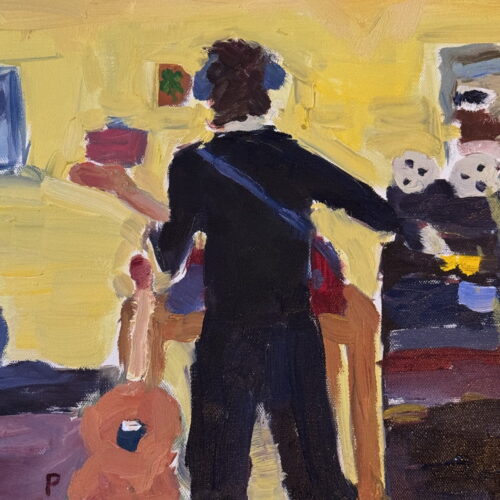
Big Lucky’s cover art was painted by McPoland himself, which was an immersive experience that kept the album’s independent spirit alive. “I think I have a hard time learning about something unless I fully do it,” said McPoland. “You know, I have a hard time understanding what makes a good album cover unless I try to make a good album cover.”
Painting was also an outlet for him to take a break from Big Lucky and explore a new medium. “When I wasn’t recording, or when I would get stumped during Big Lucky, I would go and I’d sit in the backyard and I’d just paint something,” McPoland said. “So I was learning to paint. I’m not a naturally good painter, but it’s a fun thing to try to do.”

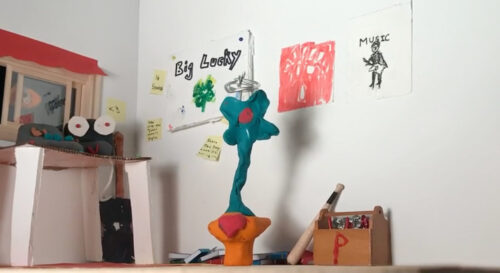
On the wall of the album’s cover art is a four-leaf clover, a popular symbol that equates to luck and inspired the title of Big Lucky. This specific four-leaf clover has been with McPoland since he was 18, but it wasn’t until Big Lucky that he shamefully realized he hadn’t paid much attention to it and decided it was time to change that.
Comparing it to a very specific childhood experience, McPoland set out to give the four-leaf clover the attention it deserves. “I think with Big Lucky, it feels like I woke up in the middle of the night and I saw the stuffed animal stuffed in the crevice and I was like, ‘I’m sorry, I’m sorry that I’ve abandoned it,’” McPoland said. “So it’s me yanking it out of the crevice and hitting the hay again. It’s just the timing of when I’ve realized it.”
Ditching his smartphone for a flip phone while creating Big Lucky, McPoland said going offline brought him to a really good place and even improved his memory. Although his internet presence has contributed to his success, taking a break from the pressure and demand of social media brought him peace and a new perspective.
“I’ve been on the internet for a while now and I wouldn’t be in this job, I wouldn’t have made it without the internet and I owe a lot to it and I’m so appreciative of it,” McPoland said. “But there’s also something nice about taking a step back every once in a while and kind of looking around.”
McPoland has thrived on TikTok, gaining traction for his posts of original songs, covers and even teasers. Having been a social media user for some time now, he said his relationship with it is different from when he first started, as the environments of the platforms have changed. “I think at some point social media and TikTok to me felt exciting and new and especially in like 2020, it felt very electric and it was exciting and it was this place to go,” McPoland said. “And then I think since then, it’s to me become this kind of routine like energy suck in a way.”
Finding the balance between appreciating the career social media gave him and acknowledging the difficulty it presents is something he tries to do frequently, making “a good step forward on it every day.”
Over time, McPoland has grown a loyal fanbase, one he said is always there for him. With the genre switches and new music releases throughout his career, the core fans seem to always show up to shows and sing along with him, giving McPoland the support that means so much to him that it is difficult for him to speak on it.
On the other hand, McPoland said he is proud of Big Lucky since it’s the best he could do, and because of that, all he truly wants is for someone to feel inspired or moved by a song from the album. “I feel like it is so rare that I hear a song and I’m like, ‘man, I love that song. Like I LOVE that song,’ you know?” McPoland said. “And so if someone could get that, that’s all that matters. To love a song is to be alive.”
As he prepares for his upcoming tour in support of Big Lucky, he reflects on his past performances. During his Piggy era, his shows included cymbal punching at the cost of bloody knuckles. While on tour, McPoland said he has the freedom to perform his discography any way he wants, even if that means channeling explosive energy by bringing back the cymbal punching, which he may or may not do for the sake of keeping his hands fully functional. “I think the fun thing about the show is that it’s kind of fun to make the songs whatever you want to make them live,” McPoland said.
McPoland is taking Big Lucky on the road with a 30-show North American tour that will begin in November 2025 and finish in March 2026. Joined by all his friends, McPoland said it’s going to be a fun time as he’s planning to go a little wacky on stage.
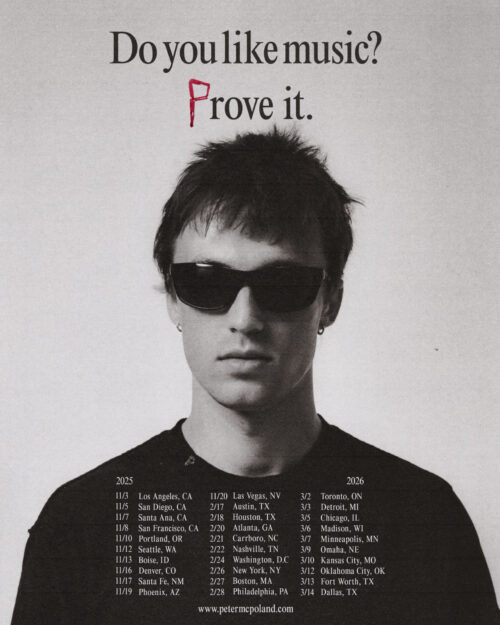
Purchase tickets here.
Pre-save Big Lucky here.
Keep up with Peter McPoland: Instagram // X // TikTok // Website // YouTube


