

For the past fifteen years, music and culture journalist Katie Bain has written about the dance music scene for practically every notable publication out there, such as The Guardian, VICE, Noisey, and SPIN. Whether she is covering icons like Swedish House Mafia, interviewing The Weeknd, or reporting on Saudi Arabia’s emerging music industry, Bain uses her music expertise to the fullest. She truly cares about the people and places she covers, travelling to different countries and reporting on both iconic and emerging artists in the process. In 2019, she became a part of the Billboard team and started reporting on the global dance scene. She is currently the senior music correspondent at Billboard, where she focuses on dance music and sustainability within the music industry. In 2016, Bain received a Cosmic Sister grant to report on traditional plant medicines in the Peruvian Amazon. Her 2023 feature on Israeli/Palestinian boy band as1one was a finalist for a Los Angeles Press Club award, and just this year, she received the first-ever FEMME HOUSE award for music journalist of the year.
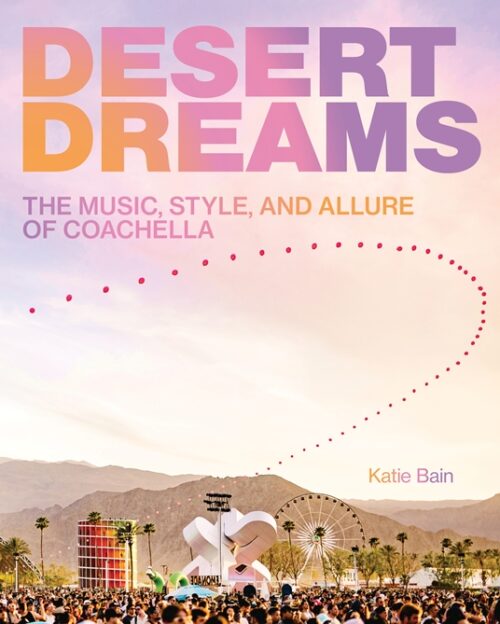
Also this year, Bain released her debut book, Desert Dreams: The Music, Style, and Allure of Coachella. As an avid fan of the festival, attending year after year after year for many, many years, Bain was the perfect person to write about this legendary event that takes place twice a year in the desert. We recently had the pleasure of chatting with Bain about the book, where she highlighted both her personal experience with the festival and its historical significance.
This interview has been edited and condensed for clarity and time.
Hi, Katie. Thank you for taking the time to talk. I have your book right here, and I thought you went into the history and legacy of this iconic festival in a way that’s really informative and relatable. How did you come up with the idea for the book, and what was it like to break down Coachella in this way?
So, Quarto—the publisher—it was their idea. They do a lot of beautiful coffee table books. They’ve done one about Burning Man. Just a lot of large format, visual-forward books. And so, they wanted to do a Coachella one, and they ultimately found me through a friend of mine who has a podcast. I was on the episode about Coachella, and so, they heard it and they reached out. That was, gosh, a year and a half ago. I think most people don’t have their first book fall in their lap, so I’m very blessed in that way.
What are some things that you learned about the book making process and possibly about Coachella in putting this together?
Yeah, I learned a lot about the book making process. But in a way, it wasn’t so different from the work that I do day-to-day at Billboard, you know, ‘cause I kind of broke it up into sections. It’s like, ‘Today, I’m writing about the fashions. Today, I’m writing about the best performances. Today, I’m writing about the history.’ So in a way, it was like writing a 30,000-word article, and I learned about the pacing of a book publishing process. I learned a lot about when things come out and why they come out. I learned about the structure of a book release.
In terms of what I learned about Coachella, I learned a lot. I thought I knew a lot when I started, and I did, but just digging into the really granular history… And I think what was cool about it for me is that for all the reporting and writing that’s been done about Coachella since 1999, no one has ever really put all the pieces together. And I’m sure that I missed things, but there’s so much out there, and I felt like I was kind of able to take it and weave it into this book. And so, that was really great for me because I love research. I love doing research, and I can go down a rabbit hole like no one’s business. And so, I really spent a lot of the second half of last year just deep-diving on, ‘What was the punk scene like in southern California in 1978?’ and just following all of these threads. Then, of course, simultaneously just watching hours and hours and hours of Coachella performances and everything I could find on YouTube.
Out of everything, which was the hardest chapter to put together and which was the easiest?
The hardest was the fashion. Because I see it, I’m out there, but I don’t know how well I participate. It’s a bit outside my realm. You know, I’m a music person, I’m a festival person, I’m a live events journalist… I felt like it took more work to speak to authoritatively and just kind of make sure I wasn’t missing anything big. So, fashion was challenging for me. I knew it was a big deal, but I had never really broken down specifically how or why or the evolution, so creating a language around that was challenging for me.
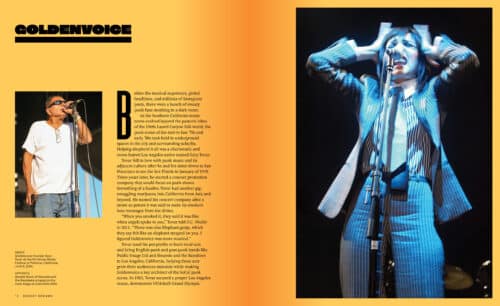
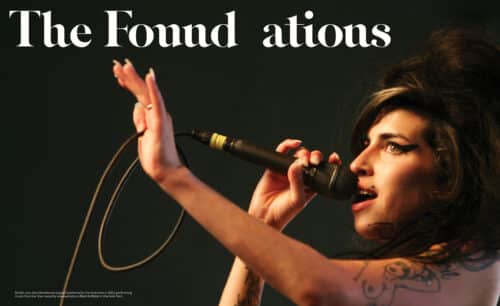
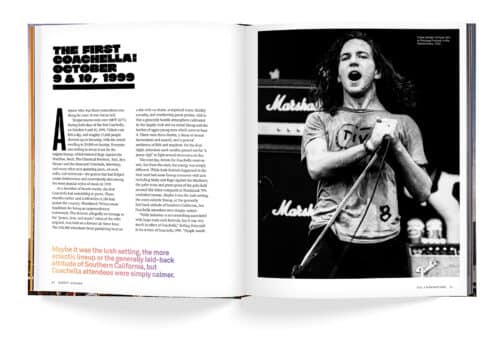
The easiest chapter was probably the history of Goldenvoice and the early years. Like I said, I love research, I can really go deep in that stuff. And then, the chapter with the 20 best performances was just fun. Some were obvious, like of course Beyoncé has to be in there, of course the Pixies has to be in there, of course Radiohead has to be in there… But, I got to decide ultimately, so there was a little bit of pressure of ‘Who am I to say?’ I say, even in the book, ‘This list is inherently wrong, no one can actually make a definitive list.’ But it was certainly fun to do that and watch all of those performances. Just sit on my couch and take notes and notice all the little details, what people are wearing, how many phones are in the crowd and how that changes year after year… I love all that stuff.
Going back to what you mentioned earlier about the 20 best performances, I can probably imagine you had a lot in mind starting out. How did you narrow it down to the ones in the book?
Yeah, that’s a good question. I think it’s performances that marked a turning point in the festival. For example, Radiohead in 2005. That was a really big band, and it kind of brought the festival up to a new level of cache. So, that was important for the overall trajectory. You know, Dr. Dre and Snoop Dogg—that was the hometown hero hip-hop performance. So, things that were either culturally significant, historically significant, and then things that were just undeniable.
If you had to pick your all-time favorite performance, what would you pick?
Ugh, so hard, there have been so many… [Overwhelmed sigh] It changes. But I was re-watching this performance a few days ago, so it’s fresh in my mind—Justice on the outdoor stage in 2017 was one of the best shows I’ve ever seen. All of my friends had left, they had all gone to see Kendrick Lamar, and I was like, ‘I think I’m gonna stay for this Justice show.’ Hans Zimmer basically opened, well he had played before, so it was this really incredible one-two, and it was really powerful. I mean, there’s always really good live, but that show… You know, I kind of started at the back of the crowd and then I ended up on the rail. It was great. It was really great. It was like gravity had just pulled me in.
I saw in your About the Author section of the book that you’ve been going every year since 2008. If you look back on the times you’ve been, what would you say was the most meaningful year of Coachella—for both yourself and for the festival?
Okay, yeah I mean, I think 2012 was a big year for the festival. I reference it a lot, but it was the year that it expanded to two weekends. I think those weekends both sold out in three hours. So, it really established Coachella as this juggernaut, and it’s been that way ever since. And then they had Dr. Dre and Snoop Dogg that year—it was just a really killer lineup and really good energy.
For me personally, I don’t think I’ve ever actually had a bad year at Coachella. But standouts…this year was really fun, last year was really fun, 2018 was really great! But personally, I think 2013 was the first time I was out there with my other journalist friends. We had a house we were staying in together, and it was the first time I felt like a real journalist. And so, that was significant for me, for sure.
Is there one year in particular that comes to mind when you think of a bizarre year or a bizarre moment you experienced at Coachella?
Oh yeah, there’s probably so many. [Laughs] Well, I mean, Frank Ocean’s headlining set in 2023 was bizarre. It was bizarre. It was a very hyped performance. He was, I think, the last headliner that was a holdover from the pandemic. The others fell off and they had to reconfigure the lineup, but Frank was there. To see the number of people in the crowd that day that was obviously just there to see him, like the energy was really palpable. And then, I started hearing rumors before the sun went down. I remember being like, ‘I heard he’s not gonna play, I heard he’s dropping out.’ And then he came out on stage, but he was about an hour late, and the performance was really strange. It was kind of a mess, and it never really gelled. There’s a lot of mixed opinions about it; I can only speak from my direct experience. I did not think it was good, and it was the only show I’ve ever been to at Coachella where—Sunday night, last show of the last night—the crowd walked off the field in silence. It was really a very eerie mood after. And so, I would say at a collective level, it was the most bizarre occurrence I’ve ever seen there. I felt for the guy—obviously, no one wanted it to go down that way. But yeah, just a very strange showing.
Who would be your dream headliner?
It’s only fantasy because he’s no longer touring, but Phil Collins. I mean, all those bangers… I would go wild for that, and I think other people would too. When that drum solo from “In the Air Tonight” would drop on the main stage, can you imagine? Can you imagine. It would be so much fun!
Looking back to some of the early years of Coachella, is there one year you would have liked to have attended?
Yes, yes, yes! As a person who covers dance music, my education will never be complete because I wasn’t at Daft Punk in 2006. And so, you know, there a lot of people who work in dance music now or make dance music—like, I don’t know what happened in that tent. They all went through something together that we’ll just never know about! So, I surely would have loved to have been there for that. And then, I’m a big Rage Against the Machine fan, and I’ve never been able to see them. So, any of the two festivals they’ve headlined, I would have loved to have been there for those.
[Somehow, I missed the Coachella lineup release, so I proceeded to ask Katie who she thinks will headline Coachella 2026…]
So, well, the lineup is out.
Okay. [Dies inside] I didn’t know that. [Laughs awkwardly]
Yeah, you never quite know what to expect. Sabrina Carpenter, Karol G, and Justin Bieber—I mean, the festival is, obviously, fully leaning into pop music. And it’s weird that at this point, Justin Bieber is the legacy act. It used to be the Pixies, and now it’s Justin Bieber. So, it’s an interesting evolution, and I think you can really track that to 2017 when Beyoncé was booked. She dropped out, Lady Gaga came in, it just kind of marked this shift into pop headliners that really would not have been seen in 1999 or 2001 back in the day.
As far as Coachella overall, where do you see the festival going, and what do you think its legacy will be going forward?
It certainly seems like it is strong at a business level. There was a lot of chatter last year—and maybe the year before—that it didn’t sell out, because Coachella always sells out! And then this year, with those three pop artists that I mentioned, I think it sold out again in a day for both weekends. And so, the taste for Coachella is strong. I don’t think there’s any reason to worry about the health of that festival. The demand is there. So, in terms of where I see it going, I don’t know. The older I get, the more I look at the lineup and I’m like, ‘I don’t really know who these people are!’ I guess, for me as I age, it would become more of a discovery event.
In terms of legacy, I think that Coachella has shown America how music festivals can be. Obviously, they were taking inspiration from Glastonbury and Reading, and they were trying to capture this type of event that was really popular and successful in Europe before we had them in America. Obviously, we had Woodstock, but then nothing for a long time. So, I think it’s the festival that really established festivals in the U.S. and then subsequently eclipsed everything else around the world. And now, with Glastonbury and with a handful of other events, it’s a world leader in how this is done.
Are there any other books that you’re thinking about writing?
There’s definitely one that I’m thinking about, but it is not related to music. It’s related to football. It’s not a sure thing yet, so I shouldn’t say too much about it—but, I’m a Green Bay Packers fan, so I’ll give you that clue.
If you had to do another music book, what do you think you would go into?
That’s a good question. I don’t think anyone’s ever really written a book about the dance music explosion circa 2010. So, I’d probably write the history of that, which I would really enjoy to do because I was there for a lot of it and I know a lot of people who were there for a lot of it. It wouldn’t be easy, but I would be a good person to do it. It’s just the world that I’m steeped in every day, so I have a fluency there.
Desert Dreams: The Music, Style, and Allure of Coachella by Katie Bain is out now via Epic Ink, an imprint of The Quarto Group. You can purchase a copy here.
Learn more about Katie Bain here.


