

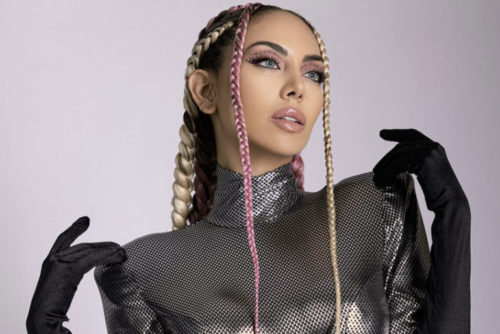
Esther Anaya is an internationally recognized DJ, violinist, and producer whose work lives at the powerful intersection of classical precision and high-energy electronic music. Classically trained from a young age, she has transformed the violin into a dynamic centerpiece of modern dance culture, seamlessly blending technical mastery with the pulse and emotion of electronic soundscapes. Her performances are not just concerts, they are immersive experiences that bridge genres, cultures, and generations.
Known for captivating audiences at major festivals, stadiums, and global cultural platforms, Esther has built a reputation as one of the most distinctive crossover artists of her generation. Whether performing alongside world-renowned DJs, headlining international events, or creating original productions in the studio, she brings a signature intensity and artistry that sets her apart in an increasingly crowded music landscape. Her ability to merge classical musicianship with contemporary beats has opened doors to new audiences and redefined what a violinist can be in the modern era.
In this interview, Esther reflects on the journey that shaped her sound, the creative risks that helped define her career, and the passion that continues to drive her forward. She also shares insight into the stories behind her music, the emotional connection she seeks to create with listeners, and how she continues to evolve as both a performer and producer in a constantly changing industry.
Congratulations on all the momentum you’ve been building recently. How do you approach blending classical violin with electronic music in your performances?
For me, it’s never been about “adding violin” to electronic music. It’s about letting both worlds elevate each other. I grew up classically trained, so the violin is my emotional language. Electronic music is my energy language. When I perform, I treat the violin like a lead vocal, it has to breathe, tell a story, and move with the crowd.
I’ll often structure a drop around a live violin riff or build tension with a cinematic string moment before releasing into a bass-driven section. It’s very intentional. I want people to feel the sophistication of classical music and the freedom of dance music at the same time.
When you’re creating new music, what inspires you most—personal experiences, global sounds, or something else entirely?
It’s definitely personal first. My music always starts from an emotional place, something I’ve lived, processed, or felt deeply. But I’m also constantly inspired by rhythm and culture. Touring exposes me to Latin percussion, European melodic structures, Afro-house grooves, Middle Eastern scales, and those textures find their way into my production.
I love blending global influences with modern dance energy. It reflects who I am: a classically trained violinist with building soundscapes for global stages.
Your live shows combine high-energy production with live instrumentation. How do you keep that balance and maintain the emotional impact for the audience?
Dynamics. That’s everything. If it’s high-energy for 90 minutes straight, you lose emotional depth. I intentionally design my sets with peaks and valleys, cinematic violin intros, vocal-driven moments, then explosive drops. The live violin gives me flexibility in real time. I can extend a breakdown, build tension longer, or interact with the crowd more organically.
I want people to dance, yes, but I also want them to feel something. That emotional contrast is what makes the high-energy moments hit even harder.
Touring globally must expose you to so many musical styles. How do these experiences influence your work?
Travel changes your ears. When you play different cities, you notice how crowds respond differently, some lean melodic, some lean percussive, some want harder drops. I absorb that energy. I’ll come home inspired to experiment with a groove I heard in Mexico City or a melodic progression that resonated in Europe.
Touring keeps me evolving. It prevents me from staying creatively comfortable.
Collaboration is a big part of your career. What do you look for in other artists when deciding to work together?
Energy and authenticity. I look for artists who care about the emotional impact of a song, not just the algorithm. Chemistry matters too. When we’re in the studio, it should feel natural and creative, not forced. I’ve been lucky to collaborate across genres, and I love when two different worlds collide. That tension often creates the most exciting records.
At the end of the day, I want collaborations to feel elevated, like both artists grew from the experience.
Technology plays a huge role in modern music. How do you use it creatively in both your studio work and live performances?
Technology is a tool, but emotion is the driver.
In the studio, I’ll manipulate violin textures through processing, layering, and sound design to create hybrid sounds that don’t feel strictly classical or electronic. Live, I use technology to trigger stems, loop violin phrases, and build live edits on the fly.
It allows me to turn a DJ set into a performance. I’m not just pressing play. I’m building moments in real time.
Music can be a powerful cultural force. How do you hope your work impacts audiences beyond entertainment?
I hope my music reminds people that they can hold multiple identities at once.
You can be classically trained and love underground dance music. You can be feminine and powerful. You can be elegant and explosive.
If someone leaves my show feeling elevated, confident, or emotionally moved, that matters to me. Beyond entertainment, I want my performances to feel empowering and unifying. Music has this incredible ability to dissolve differences and bring people into the same emotional space.
Performing in stadiums versus intimate venues must feel very different. How do you adapt your music to fit each setting?
Stadiums are cinematic, intimate venues are conversational. In a stadium, everything needs to be bigger, longer builds, dramatic violin moments, bold drops. You’re painting with wide strokes. In a smaller venue, I can be more playful and detailed. I can experiment, interact more directly, and create a closer connection. I love both because they challenge me differently. One requires scale; the other requires nuance.
You’ve developed a unique identity at the intersection of classical and electronic music. What challenges did you face in defining your sound?
Early on, there was pressure to choose one lane, be the “classical girl” or be the “DJ.” But I never felt authentic separating those sides of myself. The challenge was trusting that blending them wasn’t confusion, it was my signature. Over time, I realized the uniqueness is the power. When you fully own your identity, people connect with it in a deeper way.
Looking ahead, are there any musical directions or projects you’re excited to explore that your fans might not expect?
Absolutely. I’m excited to lean further into cinematic storytelling, almost orchestral dance pieces that feel like film scores meeting festival energy. I’m also exploring deeper melodic textures and collaborations that push my production in unexpected directions. My first release of the year “Triple Threat,” out on April 10th, will highlight this and so much more.
And creatively, I’m always thinking about how to elevate the live experience, visually, emotionally, and sonically. The goal is always growth. I never want the next chapter to feel predictable.


