

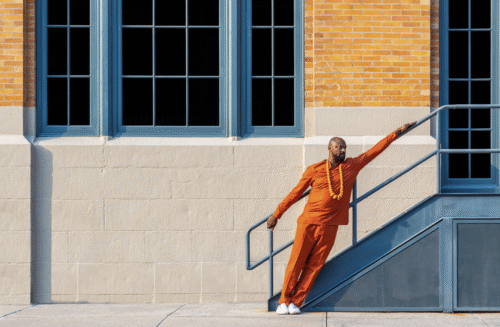
There’s a quiet daring in the way Justin Hicks approaches a song. With a voice that folds vulnerability into velvet and lyrics that hover between the personal and the mythic, Hicks isn’t just making music—he’s building worlds. He initiates meditations on becoming: prismatic, genre-defying portraits of a Black man moving through an America that often misunderstands itself. Today, Justin announced his much-anticipated upcoming debut album, Man of Style, along with a visualizer for the first single “Poly.”

Justin explains: “Poly” was written around 2011-12, and was inspired by a brief conversation my buddy had with a stranger at a local bar. The encounter sparked these lyrics about the crossroads between the different types of relationships that exist – whether the lifestyle of monogamy, polygamy or polyamory is the better choice of approach to loving someone or not. He took a risk with the lyrics for sure. It connects with people in a special way. He brought them to me and thought I might have an interesting take on the tune, so I gave it a shot at an arrangement and a track. It ends up being sort of a tragic-disco-Philly soul-meets the band Suicide vibe if that’s a thing!
Justin Hicks sings to communicate — to relate, to support, to discover, to pray, to love, and to imagine. Singing, for Hicks, is how one practices all of this essential human labor. With tenderness Hicks’ music invites us to listen and learn, and with his album Man Of Style Hicks opens a new field of intimate, sonic research.
Recorded almost entirely across two days in Long Island City, Queens, and produced with longtime collaborators Meshell Ndegeocello and Chris Bruce — Man Of Style is a biography of a voice exploring its own edge, and it’s beating heart. Hicks’ art is an experiment in singing, and in each track on Man Of Style his voice builds a bridge to the listener. As a songwriter, Hicks makes a home loitering at the edge of folk, R&B, even noise, but in the end the songs stand alone on their own terms — letters, poems, dreams, mantras, manifestos. His lyrics don’t always land in tidy conclusions. Instead, they hang in the air like unanswered questions: soft, surreal, and emotionally resonant. There’s pain, yes—but also wit, warmth, and a deep sense of play.
With this album Hicks claims a space for music that lives with you, not for you — music that takes care.
The album’s title, Man of Style, is more than a nod to fashion or polish. It’s an acknowledgment of multiplicity. Hicks is not one thing—he is many, and his music makes space for all of it. Justin’s work moves with a kind of narrative intimacy, drawing on the storytelling traditions of artists like Marvin Gaye, Roberta Flack, James Taylor, and Jeff Buckley—artists who blurred the line between confession and performance. And while the record finds kinship with more contemporary artists like Nick Hakim, Georgia Anne Muldrow, and Moses Sumney—musicians who let the work lead, his approach feels fully his own. Hicks offers not just an album, but an invitation: to feel more, to hear differently, and to embrace the strange poetry of being alive in a complicated world. It’s the kind of work that doesn’t beg for validation—it simply unfolds, confident that those meant to find it, will.
Originally from the Midwest, Justin carries the sound of open spaces in his work—fields and back porches, church basements and cracked city sidewalks. But rather than leaning into nostalgia, he invites the listener into something stranger and more beautiful: a soundscape where gospel meets art-song, where folk harmonies break into avant-garde textures, and where stories unfold like secrets told in confidence. There is clarity here, and also abstraction—Hicks isn’t interested in resolving the tension. He invites you to live inside it.
“I grew up in a college town with very religious parents who were atypically progressive. Dad was a pastor with aspirations of being a visual artist, and Mom was an educator who also sang in a folk and gospel trio. They were both somewhat frustrated artists with limited time and opportunities to share what they did, so art ended up happening at home or close to. Especially music. Self-expression was encouraged, even required in some cases. I try to archive my lineage – honoring it in what I make, how I sing, how I write because it was taught to me that music has a crucial role in bending the arc even if in a low key way. I think there is a limit to what songs can truly do, but I still think it’s worth trying to make them, to make things that a lot of people feel the need to hear and want to listen to.”
He is somewhat of a pied piper—luring interdisciplinary collaborations into his realm of expression and sound making. He has worked with artists such as Abigail DeVille, Chris Myers, Janani Balasubramanian, Charlotte Brathwaite, Jennifer Harrison Newman, Hilton Als, Lizz Wright, Joan As Policewoman, Gelsey Bell, Lynn Nottage, and Steffani Jemison as a composer, lyricist, vocalist, and sound artist. His work with Meshell Ndegeocello as a featured songwriter, vocalist, and producer on the critically acclaimed “No More Water: The Gospel Of James Baldwin” and the groundbreaking “The Omnichord Real Book” has garnered two Grammy Awards. As he began touring extensively over the last 3 years as a part of her band (“Meshell Ndegeocello is a band), Hicks curated a collection of songs written during his time in New York. While he generates quite prolifically in collaborations across disciplines, it is his commanding embrace of songwriting that renders his desire to reach out into the world most eloquently.
“I like what singing can do in terms of dealing a little dopamine, but I don’t always feel good or pleased or even pleasing, so it doesn’t feel real or right to revel in the sound of a voice just for pleasure’s sake. It’s the work of singing lyrics with a good handle on the sonic context that they appear in – that’s the thing I’m really interested in performing.
His creative reach goes far beyond the recording studio. He’s worked with luminaries in the visual art world like Steffani Jemison, and Hilton Als while co-creating groundbreaking performances in experimental opera, conceptual art, and concert theater such as the Grammy-winning No More Water, a gospel fantasia composed of fragments from James Baldwin. Whether performing in concert halls, museums, or theatrical spaces, or creating sound art and installations, Hicks meets each project with the same curious spirit: What happens when we tell the truth in an unexpected form?
This is perhaps what makes Hicks so quietly radical. He is not here to dazzle with vocal acrobatics or technology or to chase trends—which he can wield with ease. He is not loud in the way the industry often demands artists be. Instead, he builds slow-burning, lasting intimacy with the listener. His music asks for your attention—not urgently, but earnestly—and rewards it with depth, ambiguity, and beauty.
Connect with Justin Hicks:

