

FFO: Death Cab for Cutie, Arcade Fire, Phoebe Bridgers
If you asked 50 people to define “indie rock,” you would get 50 different answers. The genre has changed its meaning and identity throughout the years, so much so that “indie” is kind of just a catch-all term for anything not really conventional. Instead of representing the sounds of independent artists, it has become synonymous with hipsters, folk artists, newcomers, alternative artists—acts that are excluded from the mainstream. But, is this really what the genre embodies?
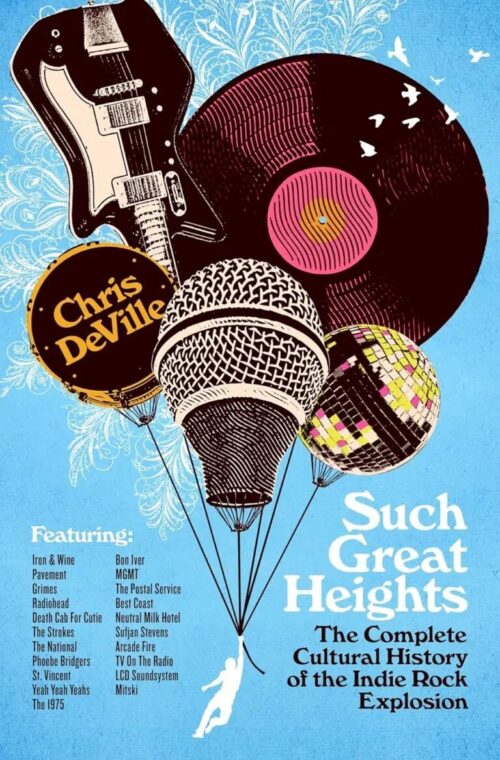
In his debut book, Such Great Heights: The Complete Cultural History of the Indie Rock Explosion, author, journalist, and Stereogum managing editor Chris DeVille breaks down the rise and evolution of indie rock. Throughout the book’s 12 chapters, we learn where it started, how it became popular, its different personalities, and where it stands today. Come down now and see what the genre is all about—because sometimes, everything does not look better from far away…
Each chapter begins with a “soundtrack,” a page that lists key artists and their notable songs that pertain to the genre. The more you advance through the book, the further into the different decades you become. For instance, chapter one’s soundtrack includes The Cure’s “Boys Don’t Cry” from 1979, Dinosaur Jr.’s “Freak Scene” from 1989, and The Flaming Lips’ “Race for the Prize” from 1999. When we get to the soundtrack for chapter 12, highlights include Parquet Courts’ “Stoned and Starving” from 2013, Lorde’s “Green Light” from 2017, Clairo’s “Bags” from 2019, and Taylor Swift’s “Cardigan” from 2020. This was a smart and creative way to set up each chapter, as readers can keep track of the time period discussed while also popping on these tracks to familiarize themselves with the content as they read.
Overall, DeVille does a fantastic job tracing the genre. He gets into the foundation of indie rock, which deals with punk, college radio, and the underground scene. From there, he mentions key players, from bands to labels to publications that all fostered the rise of the genre. Its popularity and distribution mixed with technology and culture over the years, as television shows like 2003’s The O.C., commercials for the iPod, and social media platforms like MySpace latched onto the indie rock scene.
The middle of the book is where things (at least for me) get very interesting. Here, DeVille breaks down the genre by separating it into other genres that more or less informed how indie rock would sound as it pertained to various decades. In the mid-‘00s, for example, the bloghouse and dance band scenes contributed to indie rock, resulting in new and exciting music from groups like Daft Punk and DJs like Diplo. It then dabbled in the folk genre, hip-hop genre, rap genre, and pop genre before entering the eclectic world that it thrives in today. DeVille neatly organizes these categories into their own chapter, as the stories of how and why indie rock became important within these circles are very specific and complex—but not so complex that the material is difficult to follow. DeVille’s voice is informative yet casual throughout, letting his experience with and enthusiasm for indie rock take hold.
Of course, the book leaves us with the indie rock of 2025. Who is making it? How is it perceived? While bands like The 1975 and boygenius have had quite an influence on the direction of the genre, they only play a small part in its evolution. As readers learn, indie rock is never going to settle or be associated with one style of music. Therefore, its story remains open. I would have liked for DeVille to further expand on this chapter, but this longing for more is precisely the point—there’s so much going on that it will seem like one chapter, or book, will never be enough.
Overall, Such Great Heights: The Complete Cultural History of the Indie Rock Explosion is an excellent read. I grew up in the time period when indie rock really took off and have been able to witness its uprising and evolution for myself. When I read these chapters, I am transported back to these different decades—2005, 2011, 2015, what have you—and can recall certain trends and music videos and soundtracks. I even recall bands and songs that I completely forgot about. It is a well-researched and well-explained book, and anyone who has even the slightest interest or appreciation for indie rock should familiarize themselves with all that is said across its pages.
Such Great Heights: The Complete Cultural History of the Indie Rock Explosion by Chris DeVille is now available via St. Martin’s Press, an imprint of Macmillan Publishers. You can order a copy here.


